Thursday, June 28, 2018

Poetry Friday State of Mind

       This final Poetry Friday of June is hosted by Denver friend Carol Wilcox at her blog, Carol's Corner. She's introducing a new poet and sharing some wonderful poems that offer good ways to live one's life. Thanks, Carol!


"In a day and age when all manner of things are believed against contrary evidence - hey, why not believe there's a little good in everyone. ~ Robert Brault

          I am writing. I am calling. I want everyone to have a seat at the table. And I am trying to find good things to appreciate in life. It has been a tough week, again. I suspect I should be used to it, but I'm not. Here are two poems I've written this week, the second adapted to the season from another poem, whose author is anonymous. You will understand my various states of mind when you read. 

news floods the airwaves
the only water in sight —
barren days
Linda Baie © All Rights Reserved


        State of Mind

For the books I read,
the fireflies' glow,
the picnics in the nearby park,
the home to which I go,
the lamps I light late summer’s eve,
the quiet wind sigh of the leaves,
the shout of children in evening’s glow, 
this is the summer
that I know.
Linda Baie © All Rights Reserved

   Enjoy your Independence Day with all that it means to us here in the United States!

Wednesday, June 27, 2018

Non-Fiction - Gifts from "Other"


art by Sarah S. Brannen

         Visit Alyson Beecher on Wednesdays for Non-Fiction Picture Books at Kidlit Frenzy.  From her and others, you will discover and want to celebrate terrific nonfiction picture books!  
         These times are challenging beliefs, and I wonder how many people could benefit from reading the myriad of picture book biographies of those they might know little about, people that often are considered not to be included in the mainstream of the U.S. Here are two recent books out in the past two months, about one immigrant and one Native American who both contributed so very much to our country.


          I've known something of Irving Berlin's life before, that he wrote Alexander's Ragtime Band, White Christmas and God Bless America, but Nancy Churnin has managed to write of his life from his poor beginnings as an immigrant in NYC to his extraordinary successes as a composer in a way to introduce him to young children, or those readers who want to read a short biography as a start to research. He came from Russia, in a poor family when his father died when Irving was twelve, he had to quit school to try to find ways to earn pennies to help. He loved music and singing so much that when one time he felt so full with music, he burst into song. People liked that and threw pennies. He was excited, soon was noticed by a restaurant owner who hired him as a singing waiter. The story really is a "rags to riches" tale. With a friend, he wrote his first song and they sold it for 37 cents! Irving never had formal music training, used a "transposing" machine eventually to write his compositions. The book shares a few songs I didn't know he wrote, like the score of Annie Get Your Gun that has "There's No Business Like Show Business", and a most famous one is "White Christmas. There are many others.
          There is an author's note and a timeline added in the backmatter.


       Joseph Bruchac's books have taught me much about Native Americans, and I am glad to share this new picture book that will be a marvelous introduction to Chester Nez for younger readers. Bruchac has previously written a book about this same topic for middle-grade readers and up. 
        Like so many Native Americans, Chester Nez left his home, his reservation to attend boarding school where he was forced to abandon his heritage and language in order to integrate with the white culture and to learn English. He refused to give up! Years later, that decision turned out to be a good one, for Chester and other Navajo men like him were recruited by the US Marines to use their native language to create an unbreakable military code. That language they were told to forget was needed to fight the war, and it worked! 
        Many full-page illustrations include Chester's early and close connection to home and family, shown in Amini-Holmes’ textured art, both emotional and sometimes seeming other-worldly, with a touching double-spread showing his feelings when he returned home from the terrible experiences in the war.
        The backmatter includes a timeline and a portion of the Navajo code, and also depicts the life of an original Navajo code talker while capturing the importance of heritage.

Sunday, June 24, 2018

It's Monday - The Wow of Stories


          Visit Jen at Teach MentorTexts and Kellee and Ricki at UnleashingReaders to see what they've been reading, along with everyone else who link up.  

         Thanks to Candlewick Press for the Arc of The Button War by Avi, out June 12th.


          These boys in a small town in Poland already occupied by Russians learn the harsh realities of following a leader they cannot refuse as war nears even their remote village. The main character Patryk is only twelve and hangs out with six others, one of whom reveals a glimpse of his terrible anger one time as they “played” in the forest. Patryk finds a button which competitive Jurek wants, who nearly clubs him with a tree limb to get it. After he sees it, Patryk knows he should fight back more, but the pull of the group keeps him doing things he knows are wrong and dangerous. 
         It’s hard to believe, but these villagers live so remotely, they have just heard of aeroplanes, have never seen one, until that “clap clap” noise rises over the village and bombs the school. They all survive, but their hated schoolmaster and one young boy do not. That horror begins the realization that the outside world, the war, and the Germans will come to them whether they want them or not. They begin the “button war”, the game to see who can get the “best” button from a soldier’s uniform. The tension does not leave the story as the group surges on, even after one is beaten while trying to steal one from a soldier who lives in his home. The “pull” of Jurek’s dares and the idea of winning won’t allow Patryk to stop, with terrible consequences. The surrounding story of war shows effects on many. Their beloved forest is burned to prevent hiding out. The invading Germans commandeer homes, and some decide to leave for other places to live. The village no longer feels like home but a sad part of the war.
          The story centers on Patryk’s thoughts, who knows his actions will have consequences yet is unable to pull away. I imagine reading this with students and holding important conversations about group influences and consequences. Avi has written an upper middle-grade novel that fascinates through its setting and the underlying questions of morality.


       Summer's coming and the kids at Wolf Creek Middle School have actually been given an assignment for the summer: to add to the Wolf Creek Community Time Capsule Project. Nora Tucker is looking forward to practicing her journalism skills while doing that assignment, imagining she will be reporting about hot summer days with popsicles and swims at the creek. But even before school's out, two inmates break out of the town's maximum security prison. Nothing is going to be the same. Things become more and more complicated when a new girl moves to town just a few weeks before the end and she's black. She's also a fast runner, the other thing Nora is good at. As said, it's complicated. 
        Through text messages, letters, poems, news stories and comics, Kate Messner has created a story that I found hard to put down, wanting to turn to the next page to see how the members of this community, including Nora, her family and friends, reacted to what becomes a lockdown. This time of no playing outside during the hunt for the escapees created some scares and made a few people act differently than Nora expected. It made me wonder how communities everywhere might react to this kind of situation? I enjoyed it very much.


       Yes, it's as wonderful as many are sharing. We're using more words than Minh Lê and Dan Santat did so we can share this new, marvelous story. A young boy is dropped off at his grandfather's home and he does not like it. With a glum face, he enters and the two try to watch some TV, not understanding each other's language as well as each other's likes and dislikes. It's a dilemma that is also shown in the different meals each eats for dinner. Finally, connections are made through the boy taking out his sketchbook and drawing what to me is a hero (with a wand!). Grandfather's face lights up and off they go, drawing together. That's all I'll tell. You'll need to find the book and read what happened next! Filled with color and extraordinary action, it's a book for all to help consider how we see others, without really looking, or perhaps how by really looking.

Thursday, June 21, 2018

Poetry Friday - Swap Fun

           Poetry Friday is over at Michelle Kogan's site, here! with a beautiful introduction to Margaret Simon's book just out three days ago, Bayou Song. Margaret blogs at Reflections on The Teche. Thanks, Michelle!

          I have only words of appreciation: to Tabatha Yeatts at The Opposite of Indifference for the idea of poetry swapping, to all the poets (of which there are many) who continue to send what I think of as "slow-mail smiles", small packages arriving in one's mail with wonderful words. 
            This time, my swap begins with a lovely poem with a special collaged frame from Linda Mitchell at A Word Edgewise. It feels just right to start the summer with a poem about a poet, doesn't it? Thanks, Linda!


Here's the text:


A poet

The poet doesn't invent. He listens.
                                            ~Jean Cocteau

A poet listens with all the
senses —tree, moon, flower, child, dance. An artist 
in a playground--each morning, recess. She doesn’t
simply write words…she can invent
nuances of knowing. She
begins a poem and even the pen listens.

Happy Summer, Everyone!


Wednesday, June 20, 2018

Two Poets Who Loved Nature


art by Sarah S. Brannen

         Visit Alyson Beecher on Wednesdays for Non-Fiction Picture Books at Kidlit Frenzy.  From her and others, you will discover and want to celebrate terrific nonfiction picture books!  
           Both the following books fill with words, in the stories and the illustrations! I am reminded of part of the poem "Eating Poetry" by Mark Strand, 

"Ink runs from the corners of my mouth.
There is no happiness like mine.
I have been eating poetry.  The rest is here!


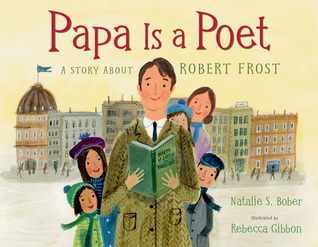
       I enjoyed the way Natalie S. Bober chooses Lesley, the oldest child of Robert Frost, to tell this story about their lives and about the life of her father. It begins with their arrival in NYC after spending over two years in England. Frost has been writing, has published two books in England, but that day he discovered that a U.S. publisher has bought his books, and they would pay him, too. He did not get paid in Europe and now he's making money as a poet! Leslie’s story is sprinkled throughout with her father’s words, when he went out into the fields, when he took the children out and taught them the names of all the flowers, when he told them about metaphor: “To think the country and not know/The hillside on the day the sun lets go/Ten million silver lizards out of snow!”  
      An author’s note, special quotations, and numerous poems are shared at the back. Illustrations are filled with details of happy times mostly out of doors. It’s a wonderful introduction to this favorite poet. 


           I recently discovered this older picture book about Pablo Neruda and beautifully illustrated with Julie Paschkis' illustrations. She has embedded his words into every possible aspect of the pages while Monica Brown writes of his love of so many things, the sea, rocks, children's play. She writes "above all things and above all words, Pablo Neruda loved people. He joined in with others fighting for justice for workers "who struggled for freedom".  Pablo Neruda was a Chilean poet who won the Nobel Prize for Literature in 1971. In the author's note, Monica Brown shares that after Neruda's death in 1973, his poet friend Yevgeny Yevtushenko, wrote: 
                              . . . he carries his poetry to the people
                              as simply and calmly
                              as a loaf of bread."